
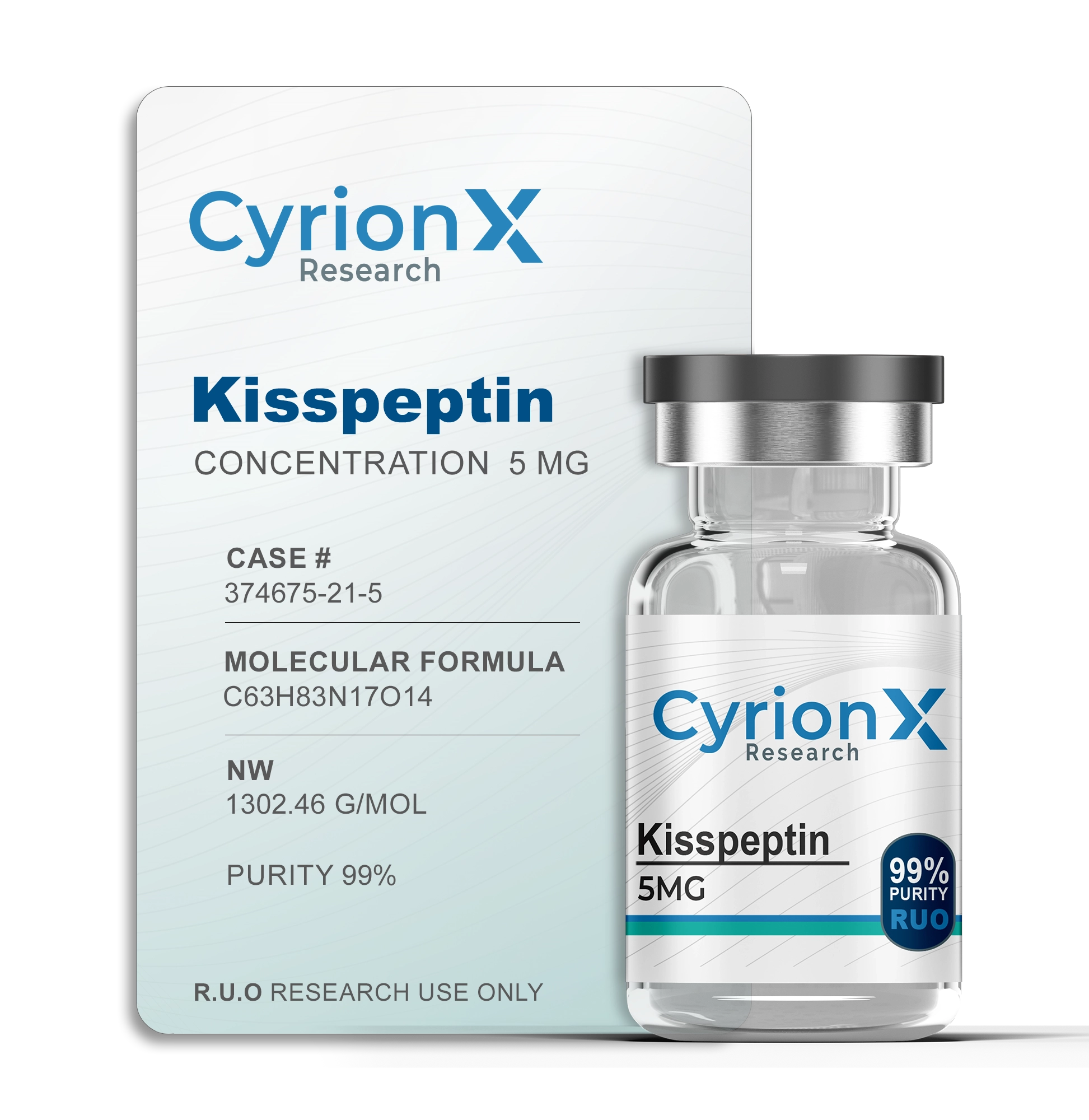
Kisspeptin – 5 mg
(KISS1-Derived Neuropeptide / Gonadotropin-Releasing Hormone Regulator)
Kisspeptin is a family of endogenous neuropeptides encoded by the KISS1 gene, known for their critical role in the regulation of the hypothalamic–pituitary–gonadal (HPG) axis. In research settings, kisspeptins are studied for their ability to act as potent upstream regulators of gonadotropin-releasing hormone (GnRH) neuronal activity, thereby influencing luteinizing hormone (LH) and follicle-stimulating hormone (FSH) secretion.
Originally identified for their metastasis-suppressor properties, kisspeptins have since become a central focus in neuroendocrinology, reproductive biology, and metabolic signaling research. Their highly specific interaction with the G-protein-coupled receptor GPR54 (KISS1R) underlies their physiological relevance in cellular communication and hormonal regulation models.
Mechanism of Action (Based on Preclinical and Clinical Research):
GnRH neuron activation:
Directly stimulates hypothalamic GnRH neurons via KISS1R, leading to downstream LH and FSH release in experimental models.
Neuroendocrine signaling:
Acts as a key integrator of metabolic, circadian, and hormonal signals influencing reproductive axis activity.
G-protein–coupled receptor signaling:
Activates phospholipase C and intracellular calcium signaling pathways through KISS1R engagement.
Metastasis suppression pathways:
Studied for inhibitory effects on tumor cell migration and invasion in cancer research models.
Energy balance interaction:
Investigated for its interaction with leptin and metabolic signaling pathways affecting reproductive function.
Potential Research Applications (Based on Preclinical Studies):
Research into hypothalamic–pituitary–gonadal axis regulation
Studies of reproductive hormone signaling and fertility mechanisms
Investigation of neuroendocrine control of puberty and gonadal function
Exploration of cancer biology and metastasis suppression pathways
Evaluation of metabolic–reproductive signaling interactions
Kisspeptin remains a critical research peptide due to its central regulatory role in neuroendocrine signaling and cellular communication.
For Research Use Only. Not for Human Consumption.
This compound is not approved by the FDA or any regulatory authority and is intended strictly for laboratory and analytical research purposes.

Reviews
There are no reviews yet.